In the space of a month, the European Union has demonstrated that its ability to weigh on its rivals depends first and foremost on its internal cohesion, and that this cohesion remains exposed to national calculation. The Usmanov episode, the Franco-German push on trade and the rulings of the Court of Justice all point to a single reality: whether facing Russia or China, the European instrument is worth only as much as the unity of the Twenty-Seven and the legal soundness of the procedures that carry it. When a member state trades away a sanction to protect a national interest, it is the collective lever that erodes. When two driving states call for faster trade tools, it is because the current sluggishness leaves the field open to Asian partners.
For a decision-maker, the question is not whether Brussels legislates, but whether the European framework remains predictable when it collides with the balance of power among states. The period shows that this predictability now rests on two distinct and at times contradictory pillars: the political discipline of national capitals, forever negotiable, and the rigour of the Union's judge, which bolsters the authority of regulators while opening avenues of appeal against their decisions. Both determine the Union's credibility as an actor capable of holding its line against Moscow and Beijing.
Sanctions: a collective weapon undermined by national interests
The Usmanov affair throws light on the most sensitive point of friction in the European apparatus. To secure the removal of the Russo-Uzbek billionaire from the blacklist, France led an offensive that went so far as to threaten to let all 3,000 individual sanctions targeting Russian officials lapse on 22 September. This mechanism exposes the structural vulnerability of the regime: because renewing the measures requires unanimity, a single state can hold the entire edifice hostage to serve a purpose of its own. Luxembourg, moreover, set its own conditions concerning another oligarch, a sign that the knock-on effect of such manoeuvres is real.
The quid pro quo materialised the day after the agreement sealing the delisting, with the release of French citizen Martin Ryan, detained in Azerbaijan. The sequence lays bare the political price of such pragmatism: criticism from the Ukrainian Foreign Minister, Andrii Sybiha, pointed to the weakening of the unity of the Twenty-Seven against Moscow, while French Minister Benjamin Haddad saw it as a victory for European solidarity. A decision-maker's reading must grasp the tension between these two registers: the instrument remains powerful, but its coherence hinges on each capital's willingness not to divert it.
This fragility does not amount to collapse. The Council extended by one year the individual sanctions tied to Russia's destabilising actions and renewed until October 2027 the measures targeting Russian hybrid threats. The Union also added 10 individuals and 17 entities involved in the deportation of Ukrainian children. The apparatus holds, but each renewal deadline becomes an opportunity for bargaining, and thus a point of uncertainty for anyone dependent on the stability of these lists.
The Franco-German partnership in search of a swifter trade lever
The same logic transfers to the trade arena, where speed of action becomes the decisive stake in dealing with China. In a joint position paper, France and Germany urged the Commission to equip itself with far faster and more forceful action tools, explicitly targeting China's distortive practices. The timing is not neutral: the initiative came as the Trade Commissioner, Maroš Šefčovič, was preparing a trip to Beijing. The two capitals thus sought to arm the negotiation before it opened. The Commission welcomed the contribution, underlining its convergence with its industrial competitiveness strategy.
This external resolve is coupled with an internal constraint that limits its room for manoeuvre. France is grappling with the fallout of the energy crisis and hybrid threats: Emmanuel Macron called for an emergency plan to protect critical infrastructure against drones and cyberattacks, and announced his intention to convene an extraordinary G7 meeting to stabilise energy prices. Paris extended its fuel subsidies until the end of 2026, at a cost of €450 million, while announcing a €54 billion savings plan for 2027 in order to return below the 3% of GDP deficit ceiling demanded by the Commission by 2029. A state calling for a more assertive Europe abroad is therefore doing so under heavy domestic budgetary constraint, which conditions its capacity to carry others along.
The judge, guarantor of the framework's credibility against the balance of power
Set against these political bargains, the Court of Justice stands out as the pillar that gives the European framework its robustness. By rejecting Zalando's appeal against the calculation of the supervisory fee under the DSA, the General Court bolstered the Commission's authority in enforcing a regulation that the large, often non-European platforms seek to contest. It is precisely this legal solidity that sets the European digital instrument apart from the sanctions negotiable in the Council: it withstands pressure better.
The Court nonetheless recalled that this authority is not without limits. In ruling that placing an aircraft on the European flight-exclusion list constitutes an act that can be challenged before the Union's courts, it opened an avenue of appeal against the Commission's administrative lists, a logic that could inspire further litigation. On the same day, it extended non-discrimination rights to workers holding several contracts concurrently. For economic actors, these rulings confirm that the sought-after predictability will come more reliably from the judge than from the trade-offs of the Council.
In brief
- The European Data Protection Supervisor, Wojciech Wiewiórowski, relayed trade-union concerns over the "Digital Omnibus" project championed by the Irish presidency, which could authorise the exploitation of workers' data without consent to train artificial-intelligence models.
- Emmanuel Macron tasked his government with a plan to protect critical infrastructure against drones and cyberattacks.
To watch
- 15/10 — 16/10/2026: European Council in Brussels, with industrial competitiveness, defence, migration and the multiannual budget on the agenda.
- 29/10 — 30/10/2026: European Union-Canada Summit in Montreal, centred on critical raw materials, energy and defence.
- 11/11/2026: Commission expected to present its circular-economy legislation, aimed at reducing the Union's strategic dependencies.
Key takeaways
- Renewing Russian sanctions requires unanimity, allowing a single state to hold the edifice hostage to serve a national objective.
- France and Germany are calling for faster trade instruments against China, but Paris is acting under heavy domestic budgetary constraint.
- The Court of Justice bolsters the Commission's authority over the DSA while opening avenues of appeal against its administrative lists.
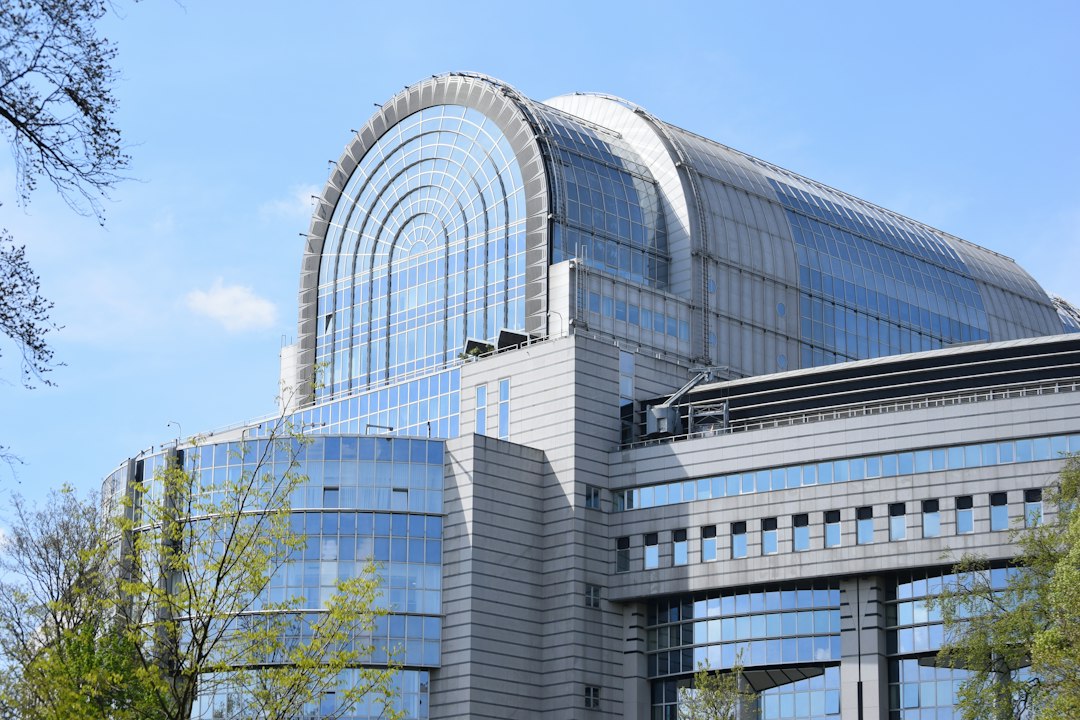
Photo: Jannik / Unsplash
Get the European Policy briefing by email
Monthly intelligence on european policy, curated with AI and reviewed by senior analysts. Available in English, French and Italian.
Subscribe for free