The Affirmation of a Distinct Pontifical Style
Six months after his election, Leo XIV remained a relatively enigmatic figure on the international stage. Where Francis multiplied striking declarations and sometimes improvised media interventions, his successor cultivated a form of restraint that could be mistaken for withdrawal. This journey dispels that impression by revealing a Pope who fully assumes his geopolitical dimension, but according to a method distinctly different from that of his predecessor.
Leo XIV has not renounced Francis’s legacy on social issues, maintaining concern for the poor, migrants, and the environment at the heart of his discourse. But his diplomacy is more rooted in the tradition of the Holy See, more cautious and more institutional. When questioned about Gaza, he refrained from using the word “genocide” that Francis had let slip, preferring a balanced formulation evoking “characteristics of genocide according to some experts.” This nuance reveals a pontificate that intends to weigh its words and avoid striking formulas likely to compromise diplomatic channels.
The choice to add Lebanon to a journey initially planned by Francis for Turkey alone is in this respect a founding act. This personal decision transforms an ecumenical pilgrimage into a high-intensity geopolitical journey and testifies to a willingness to engage on issues of peace in the Near East from the early months of the pontificate. It also reveals an assumed risk-taking: by traveling to a country where Israeli bombs continue to fall despite the ceasefire, Leo XIV exposes himself to the unexpected and accepts that his peace message be tested against the facts.
Turkey: The Ambiguities of Dialogue with Authoritarianism
The Turkish stage of the journey highlights one of the fundamental tensions in pontifical diplomacy: how to maintain dialogue with authoritarian regimes without appearing to condone them? This question takes particular acuity in the Turkish case, where the drift of the Erdogan regime has accelerated considerably since 2023.
The Turkey that Leo XIV visits is no longer the one that aspired to join the European Union. The arrest of Istanbul Mayor Ekrem İmamoğlu in March 2025, Erdogan’s main rival for the presidency, triggered massive demonstrations violently suppressed, more than a thousand arrests in a single week, and confirmed the shift toward a fully authoritarian model. The European Parliament adopted in May 2025 a scathing report denouncing the continued deterioration of Turkish democracy. Accession negotiations have remained frozen since 2018, and no one seriously envisages their resumption.
In this context, the meeting between the Pope and Erdogan takes on special significance. For the Turkish president, this visit offers an opportunity for international rehabilitation after months of growing diplomatic isolation. Erdogan has cultivated for years a façade of proximity with pontifical diplomacy, receiving successively Benedict XVI and Francis, and himself visiting the Vatican. This relationship allows him to soften his image abroad while pursuing his policy of internal Islamization, symbolized by the controversial reconversion of Hagia Sophia into a mosque in 2020.
The Pope will have to navigate between several pitfalls. Directly addressing human rights issues risks compromising dialogue and the protection of Christian minorities in Turkey. But complete silence on the suppression of opposition would appear as a moral endorsement of the regime. The Holy See’s traditional solution consists of conveying these messages in private rather than in public, but this discretion has its limits when violations are so massive and documented.
The choice not to visit Hagia Sophia, converted into a mosque, illustrates this diplomacy of avoidance. By visiting the Blue Mosque but not the former Byzantine basilica, Leo XIV sidesteps symbolic confrontation while demonstrating his openness to interfaith dialogue. This prudence exposes the Pope to accusations of complicity with a regime that instrumentalizes religion for political purposes.
The question of Turkey’s Christians, reduced to 2% of the population after the genocides of the early twentieth century, remains largely obscured. Christian communities enjoy no official legal status, their properties remain contested, and their freedom of worship remains hindered. The Pope will visit Christian institutions and meet with leaders of different Churches, but it is unlikely he will obtain concrete commitments from Ankara on improving their situation.
Ecumenism as a Geopolitical Instrument
The official heart of the journey to Turkey lies in the commemoration of the 1,700th anniversary of the Council of Nicaea, held in 325 in present-day İznik. This ecumenical celebration, which will bring together the Pope and the Patriarch of Constantinople Bartholomew I for the signing of a joint declaration, goes far beyond religious dimensions to take on major geopolitical significance.
The Council of Nicaea was the first ecumenical council in Christian history, the one that established the common doctrinal foundations for all Churches: the Creed that affirms the consubstantiality of the Son with the Father, and which remains recited today by both Catholics and Orthodox. By celebrating this shared heritage, Leo XIV and Bartholomew I intend to demonstrate the fundamental unity of Christianity beyond historical divisions, and to propose a counter-model to fragmentation and religious nationalisms.
The absence of the Moscow Patriarchate from these celebrations is the most significant rupture of this journey. Since Patriarch Kirill qualified the invasion of Ukraine as a “holy war” and gave unconditional support to Vladimir Putin, relations between the Vatican and the Russian Orthodox Church have collapsed. Francis had long attempted to maintain dialogue, even attracting criticism for his reluctance to explicitly condemn the Russian aggressor. Leo XIV, who clearly demonstrated his support for Ukraine from his election and received Volodymyr Zelensky at the Vatican, assumes a firmer line.
By de facto excluding Moscow from the celebrations of Nicaea, the Pope and Bartholomew I draw a line of demarcation within the Orthodox world. They reinforce an ecumenism based on dialogue and openness, against a Russian Orthodoxy retreated into nationalist phyletism and instrumentalized by political power. This polarization will have lasting consequences for the balance of Eastern Christianity, strengthening the Rome-Constantinople axis against Moscow.
For Bartholomew I, Patriarch of a Church reduced to a few thousand faithful in Turkey but retaining primacy of honor over all Orthodoxy, this Roman support is precious. The Ecumenical Patriarchate is indeed contested by Moscow, which claims de facto leadership of the Orthodox world and broke communion with Constantinople after the recognition of the Ukrainian Orthodox Church in 2019. Leo XIV’s visit consolidates Bartholomew’s legitimacy and his role as a privileged interlocutor of Rome in ecumenical dialogue.
This geopolitical dimension of ecumenism should not obscure its spiritual scope. The joint declaration of Nicaea, if it echoes the major themes of Catholic-Orthodox reconciliation, will constitute an important milestone in a reconciliation process that has continued since the Second Vatican Council. It could pave the way for new advances on issues that still divide the two Churches, notably papal primacy and episcopal collegiality.
Lebanon: Positioning Oneself as a Mediator in a Conflict Without Solution
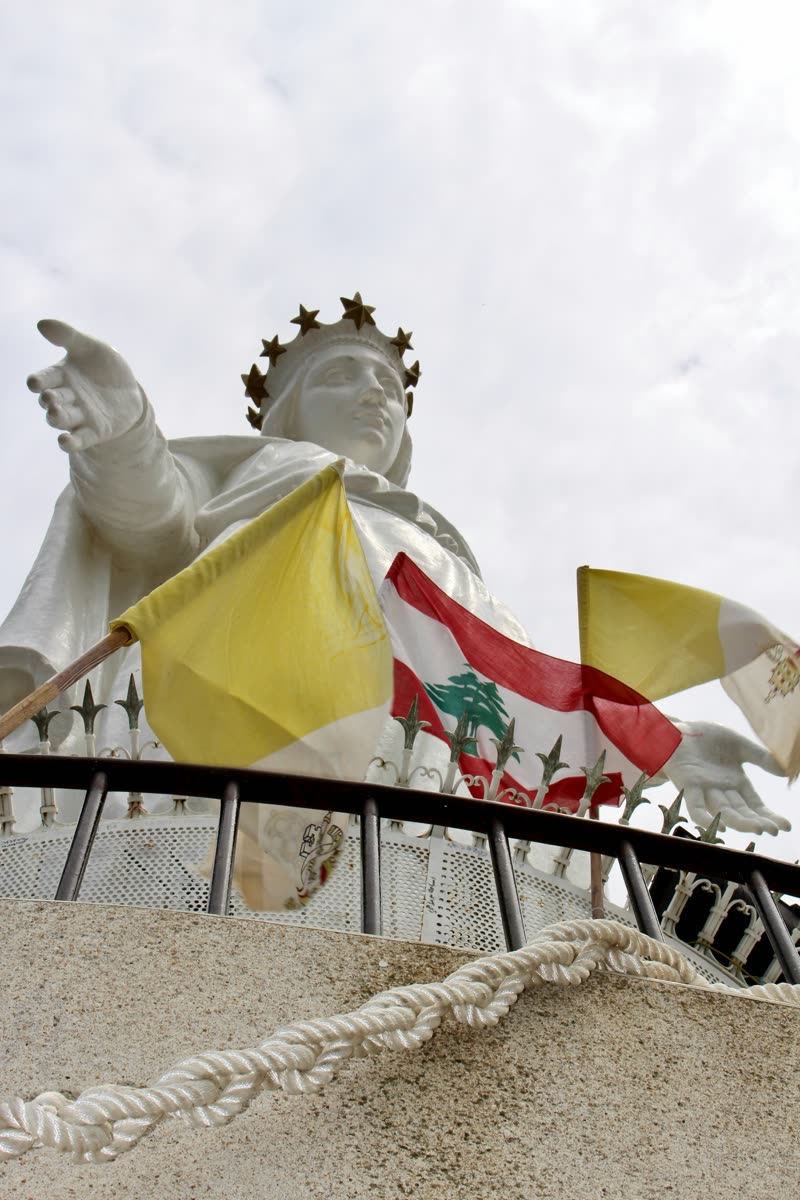
The Lebanese stage of the journey constitutes the riskiest and most significant moment of the journey. By traveling to a country where Israeli bombs continue to fall despite the ceasefire of November 27, 2024, Leo XIV directly exposes himself to the consequences of war and makes a strong diplomatic gesture.
The Lebanon that the Pope visits is a failed state in the proper sense. The economic collapse that occurred since 2019 has halved GDP, caused the Lebanese pound to lose 98% of its value, and plunged more than 80% of the population into poverty. Public debt exceeds 280% of GDP, the country has been in default since March 2020, and public services barely function. To this economic catastrophe was added the tragedy of the Beirut port explosion in August 2020, whose perpetrators have still not been identified or tried five years after the events.
On the political level, Lebanon has just emerged from more than two years of presidential vacancy thanks to the election of Joseph Aoun and the appointment of Nawaf Salam as Prime Minister in January 2025. These designations were only made possible by the weakening of Hezbollah, decapitated by Israeli strikes that killed Hassan Nasrallah in September 2024, and by the fall of the Assad regime in Syria the following month. The new government, which has lost the blocking third held by the Shiite pair Amal-Hezbollah, is attempting to undertake reforms but encounters considerable resistance.
The Pope’s visit occurs in an extremely degraded security context. Despite the ceasefire, Israel continues almost daily bombing of Lebanese territory and maintains military positions in violation of the agreement. A few days before the Pope’s arrival, on November 23, 2025, an Israeli strike killed the military leader of Hezbollah in the southern suburb of Beirut, causing a new escalation of tensions. The Lebanese president ordered the army to retaliate after a bombing narrowly missed destroying a barracks.
In this context, the papal message of peace encounters brutal reality. Leo XIV issued a direct appeal “to Israel and Hezbollah: seek peace,” resuming the traditional posture of the Holy See which refuses to take sides between belligerents. But this equidistance becomes increasingly difficult to maintain when one of the camps openly violates the ceasefire it itself signed. The Pope will inevitably be questioned about Israeli bombing, and his answer will be scrutinized both in Jerusalem and in Tehran.
The choice to travel to Lebanon rather than to Israel-Palestine reveals the constraints that weigh on pontifical diplomacy. A visit to the Holy Land, traditionally balanced between the two parties, appears impossible in the current context. It would expose the Pope to instrumentalization by one camp or the other, and risk compromising the rare dialogue channels that the Vatican maintains with all actors in the conflict. Lebanon offers an alternative: close enough for the message to resonate, distant enough to preserve diplomatic maneuver.
Christians of the Orient: Supporting Without Taking Sides
The question of the survival of Christians in the Near East constitutes one of the red threads of the papal journey. This concern, constant in Vatican diplomacy for decades, takes particular urgency in a context where emigration is gradually emptying the region of its Christian populations.
In Lebanon, Christians still represent approximately one-third of the population, an exceptional proportion in a Middle East where they no longer exceed 5% on average. This presence is guaranteed by the Lebanese confessional system that distributes positions of power among communities: Maronite president, Sunni Prime Minister, Shiite speaker of parliament. But this system, designed to protect minorities, is also a source of blockages and clientelism, and did not prevent the collapse of the state.
The economic crisis particularly strikes Lebanese Christians, who do not benefit from the solidarity networks of Muslim countries that their Sunni or Shiite compatriots enjoy. Maronite Patriarch Béchara Raï stressed that “Christians of Lebanon can only count on the Church,” whose resources are significantly more limited than those of Gulf states or Iran. The massive emigration that results threatens the country’s demographic balance: Christians represent approximately 80% of the Lebanese diaspora, estimated at between 4 and 14 million people.
This situation places the Pope before a dilemma. Supporting Christians of the Orient is an obvious priority for the head of the Catholic Church. But this support must not appear as a taking of sides in the sectarian conflicts that tear the region apart. The constant policy of the Holy See in Lebanon has been to refuse to align with one faction or another, in favor of a general appeal for peace and national reconciliation.
Patriarch Raï himself illustrates this tension. While calling on Hezbollah to return its weapons to the Lebanese state, he warned against a “forced disarmament that would tear Lebanon apart.” This nuanced position, which recognizes the necessity of state monopoly on violence while refusing head-on confrontation with the Shiite movement, reflects the complexity of Lebanese balances. The Pope must conform to this, at the risk of disappointing those who expected a more explicit condemnation of Hezbollah.
The visit to the Beirut port explosion site will constitute the most symbolic moment of the Lebanese stage. Five years after the tragedy, the investigation has still not concluded due to the systematic obstruction of the political class. By paying silent tribute to this place of mourning, the Pope will express solidarity with the families of victims and recall the requirement for justice. But he can go little further without running into the realities of Lebanese power, where alleged perpetrators continue to occupy positions of influence.
Conclusion
Pope Leo XIV’s first apostolic journey to Turkey and Lebanon constitutes a founding act that reveals the ambitions and limits of his nascent pontificate. By choosing the Near East as his first destination, the Pope asserts his will to place peace and the unity of Christians at the heart of his international action. But he also exposes himself to the contradictions of a region where political, religious, and geopolitical fault lines overlap in a complexity that defies simple solutions.
This journey marks several significant ruptures. A break with Francis’s style, in favor of a more traditional and more institutional diplomacy. A break within the Orthodox world, with the marginalization of the Moscow Patriarchate in favor of the Rome-Constantinople axis. Finally, a break in the perception of the pontifical role, with Leo XIV fully assuming his geopolitical dimension while refusing the sustained media attention of his predecessor.
This journey inaugurates a pontificate that intends to weigh on world affairs, but according to modalities distinct from those of Francis. Leo XIV wishes to be a mediator rather than a prophet, a diplomat rather than a tribune. This posture carries its own risks: that of ineffectiveness, that of perceived complicity, that of withdrawal in the face of the urgencies of the moment. But it also offers opportunities: to reweave threads of broken dialogue, and to propose a word of peace that is heard because it is audible.
Get our monthly briefings by email
Sixteen thematic briefings on global affairs, EU policy, defence, energy, agrifood, health and more. Curated with AI, reviewed by senior analysts, in English, French and Italian.
Subscribe for free